


Editor's note: We judge the seats on how two people can actually use them together.
We checked airline maps and product pages. Aircraft, seat assignments and availability can change. Images are for illustration purposes only.Two business-class seats can share a row and be too far apart for an easy conversation. Choose the aircraft and row around what you want to do together.
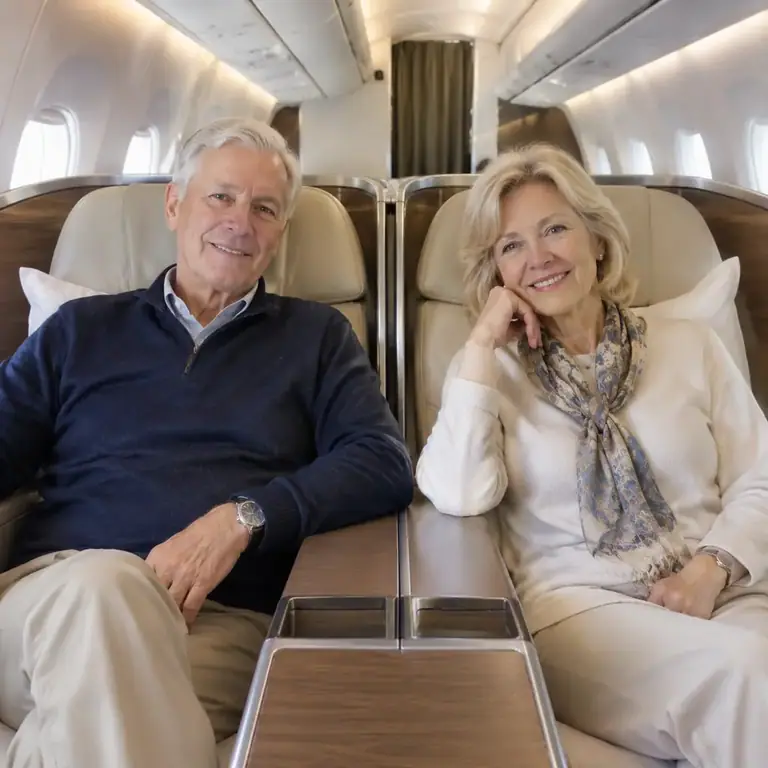
1. Qsuite center pairs can turn two suites into one shared space

Select Qatar Qsuite center seats have a movable divider and can form a double bed. The airline also offers suites configured around a group of four.
Use the map for the actual flight and choose the paired seats, rather than two center seats that happen to be free. Let each traveler keep their own aisle access.
2. Singapore Airlines marks paired beds on its A380 map

The Singapore Airlines A380 seat map uses a special symbol for business seats that can form a double bed. Start with those symbols if sharing a sleeping area is what makes the trip special.
The map has a separate category for First Class Suites. Find the business section first and match the row to the one actually offered for your flight.
3. Iberia's new-generation A350 gives the center pair a divider

Iberia describes a flat bed, separate door and automatic divider on its newer A350 business-class cabins. A movable divider lets two passengers talk and gives each one privacy later.
Confirm that the booking shows the newer configuration. A familiar airline and aircraft family can still offer several different seat maps.
4. Lufthansa Allegris has a distinct paired suite
Lufthansa describes two seats in its Allegris Business Class Double Suite. The seat is one specific configuration in a cabin that also has other seat types.
Look for the suite on the flight and read the reservation rules before setting a price limit. Two seats in regular Allegris rows buy a different layout.
5. ANA's THE Room pairs width with a privacy door

The ANA 777-300ER cabin guide shows THE Room and links the seat map. The center configuration lets you start with two generous seats and their exact position relative to each other.
Look at the direction the seats face on your row, then inspect the space between them. Choose the pairing if you will like each seat when the divider is up as well as down.
6. Center suites on Delta offer a privacy option
Delta One calls out doors and privacy dividers on most A350 and A330-900 flights. Use the aircraft-specific seat map to see what your center row looks like.
This arrangement suits two people who want adjacent private spaces. On an overnight flight, the ability to close the divider can be as useful as opening it at dinner.
7. Etihad's A380 has center positions you can inspect before paying

The official Etihad A380 map shows where the business positions sit in relation to the aisles. Compare the direction and stagger as well as the row numbers.
Treat an A380 cabin and a smaller aircraft as different products. Our business-class cabin comparison helps put the seat decision alongside the rest of the fare.
8. Qatar's older 777 layout offers a different kind of pairing
Qatar's 777 fleet page describes more than one arrangement, including a 2-2-2 configuration. A pair from that cabin can suit travelers who want a familiar side-by-side layout and expect to stay awake.
Look at how the window traveler reaches the aisle if the neighbor is asleep. That can matter more on a long overnight leg than the gap between the seats.
9. A movable divider turns the center seats into a useful pair
The best test is what happens after takeoff. Look for a photo or official diagram showing the actual center partition open, then look again with it in place.
A low divider makes normal conversation easier. A full divider may suit two people with different meal and sleep plans.
10. Two seats sometimes share a row without sharing an armrest
In staggered cabins, the console can sit between the passenger and the other seat. Two seat letters in the same row do not tell you how near the heads are.
Check the drawing for seat shells and side tables. If you will have to lean around both consoles, think about whether two windows would be more enjoyable.
11. A paired aisle layout gives both travelers a way out

One seat in from each aisle can give both travelers access without climbing over a sleeping partner. That helps when one person gets up often and the other sleeps for most of the flight.
Look at where the doors open and where the crew serves the seats. The same map can show how much independence the pair will have.
12. Across the aisle works for short conversations
Two aisle-facing seats can be useful if you want to exchange a few words during boarding and then settle separately. The gap is less convenient during drink and meal service.
Avoid relying on a conversation across carts or other passengers. Try the layout when privacy and sleep matter more than sharing the whole journey.
13. Two window seats work when you mostly want the view
One window seat behind another gives each traveler a window, their own place to rest and a similar view. On a long route with attractive scenery, that can beat the center choice.
Choose this if you are comfortable catching up after the flight. Check where the window falls in the seat shell so the reason for choosing it still holds.
14. A forward-and-rearward mix can divide a couple's preferences
Cabin pairs can face in different directions or sit in rows that alternate. If one traveler strongly prefers to face forward, check that detail before choosing the closer pair.
Pick a direction that both travelers will accept at takeoff and landing. The airline's own view of each configuration is usually clearer than a search result photo.
15. The front row can put a console or shelf in a different place

A front-row seat often has a wall in front instead of another seat shell. That can change the space around the feet, the storage and the view of your neighbor.
Look for the exact cabin and row in the carrier's photos, especially when the row is sold at a premium. It may also be near the galley.
16. Two good seats can be too close to the galley for light sleepers
A galley near the pair can bring light and preparation sounds during the night. A door helps with some activity while leaving openings above or near the floor.
Count rows from the galley and lavatories before paying for a front seat. Our long-haul flight mistakes guide describes other choices you will notice after lights out.
17. A short daytime segment changes how much the seat pair matters
An afternoon departure gives couples more time to eat and talk before sleeping. A useful divider and easy conversation can justify selecting the pair even on a route where you use the bed only briefly.
If the only good pair is on the short connection, spend selection money first on the long segment. See daytime and overnight seat differences.
18. A red-eye is mostly about two separate beds
On a late departure, the couple may eat at different times and want to get to sleep promptly. Separate controls and a clear route to the aisle can make the pair feel better.
Check how the seats recline and whether the aisle neighbor must get up for either person to leave. Sleep is why many travelers consider business class over premium economy.
19. A route search needs the operating airline

A flight sold by one airline can be operated by another. Its cabin, seat rules and meal service follow the operator rather than the name at the top of the booking page.
Open the operator's map using the flight and date. This is especially useful when you are transferring points or buying a fare you cannot change freely.
20. The same aircraft family can hide more than one layout
The aircraft name is a starting point, not a seat guarantee. Compare the row count, seat letters and placement of the center block with the official map.
If the matching diagram is unclear, ask the airline for the configuration before paying a seat charge. The overall fare still has to work if equipment changes.
21. A seat fee for two needs a two-person total
If a fare charges to choose seats, price the full selection for both passengers and on both directions where it matters. A one-seat screen can make the pair look less expensive than it is.
Write down the upgrade difference before deciding. Our flight-upgrade guide puts another price tag in context.
22. Two travelers on separate tickets should confirm their seats separately
Travelers who book with different points or cards may have separate reservations. Select the pair in each record, then confirm both seat assignments show on the same flight.
Ask the airline if it can note the passengers are together. Treat the note as a useful record, with each booking still needing its own verification.
23. An aircraft change can move both passengers apart
Check the seating a few days before departure and again at check-in. Choose a fallback pair on the new layout before speaking with the airline.
One call works better if you can name both preferred seats and explain that either traveler can move. Our airline changes guide covers related booking details.
24. A small premium may be easier to justify than a long connection

Two great seats can make the crossing enjoyable. Several extra hours in transit can still take up more of the trip than the shared cabin gives back.
Compare the pair against a nonstop flight, including the airport time on both ends. Use the timetable to decide how much the preferred layout is worth.
25. A staggered pair on the way home might be good enough
The return trip often comes with a different departure time or aircraft. Choose the layout that serves the plans for that leg.
That may mean a close pair on the way out and two independently accessible seats on the way back. First-time business class habits also vary depending on the hours you are flying.
26. The right pair is the one both travelers would choose alone
Before paying, name the main reason to sit close, then ask whether either person loses sleep, access or a window in the selected pair. Look again at the price for two.
A useful final choice is usually clear once each seat is good by itself. Keep a copy of the official map and the confirmed assignments on the same device before the trip.
Photo credits
- Qsuite on Qatar Airways Boeing 777-300ER.jpg by Raymondeuro. CC BY-SA 4.0. Cropped to square and converted to WebP.
- Singapore Airlines Airbus A380 9V-SKN Singapore 2024 (01).jpg by Bahnfrend. CC BY-SA 4.0. Cropped to square and converted to WebP.
- ANA Boeing 777-300 at Beijing Capital International Airport.jpg by Zheng Zhou. CC BY-SA 4.0. Cropped to square and converted to WebP.


