

Editor’s note: This article offers general cruise-planning guidance.
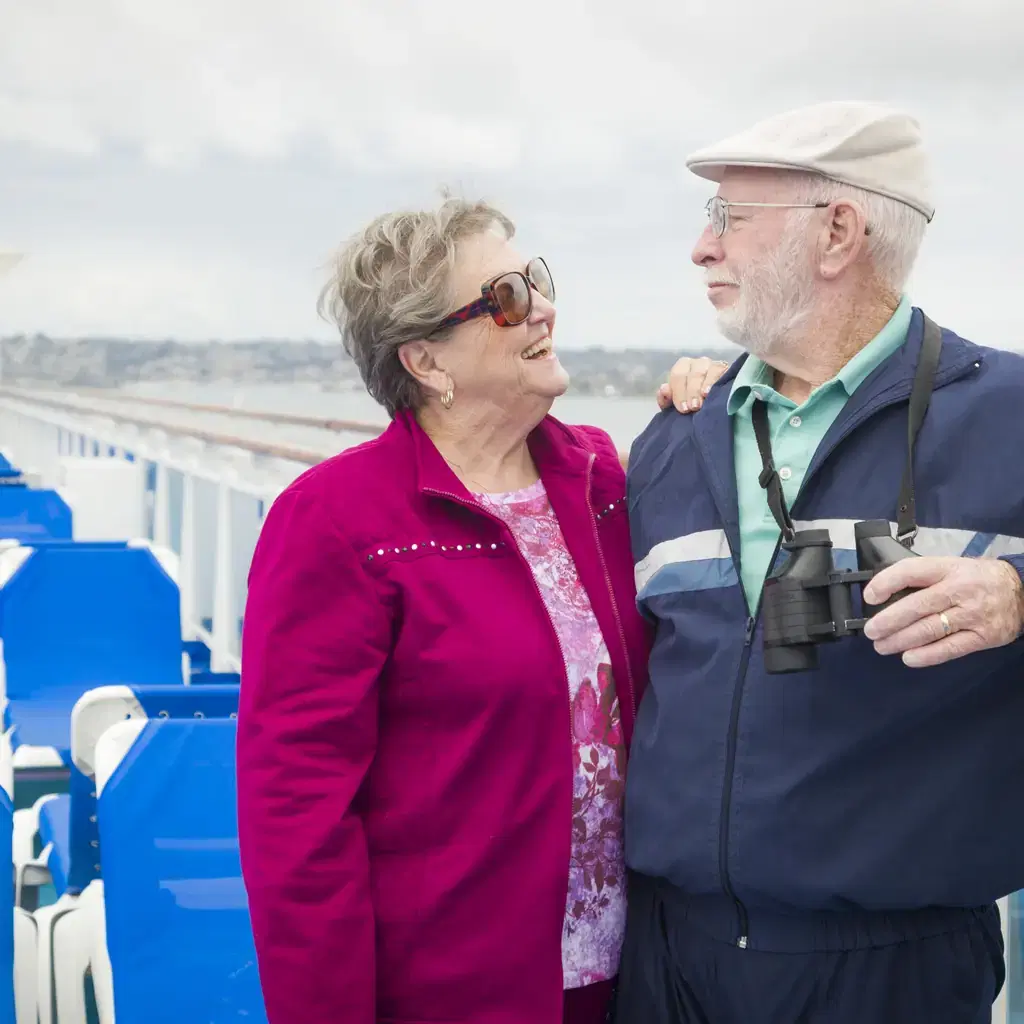
Many brochures describe cruises as the perfect vacation for octogenarians. Freedom, relaxation, adventure, new friendships, all aboard. But some aspects of cruising are challenging. Here are some tips to make cruising in your 80s easier and more fun.
The Ship Is a Small City, and Your Cabin Is Your Base Camp
Remember, on a modern ship, just getting to breakfast can be a journey.
It may involve riding two sets of elevators, traipsing through casino, photo gallery, endless halls.
Plan accordingly.
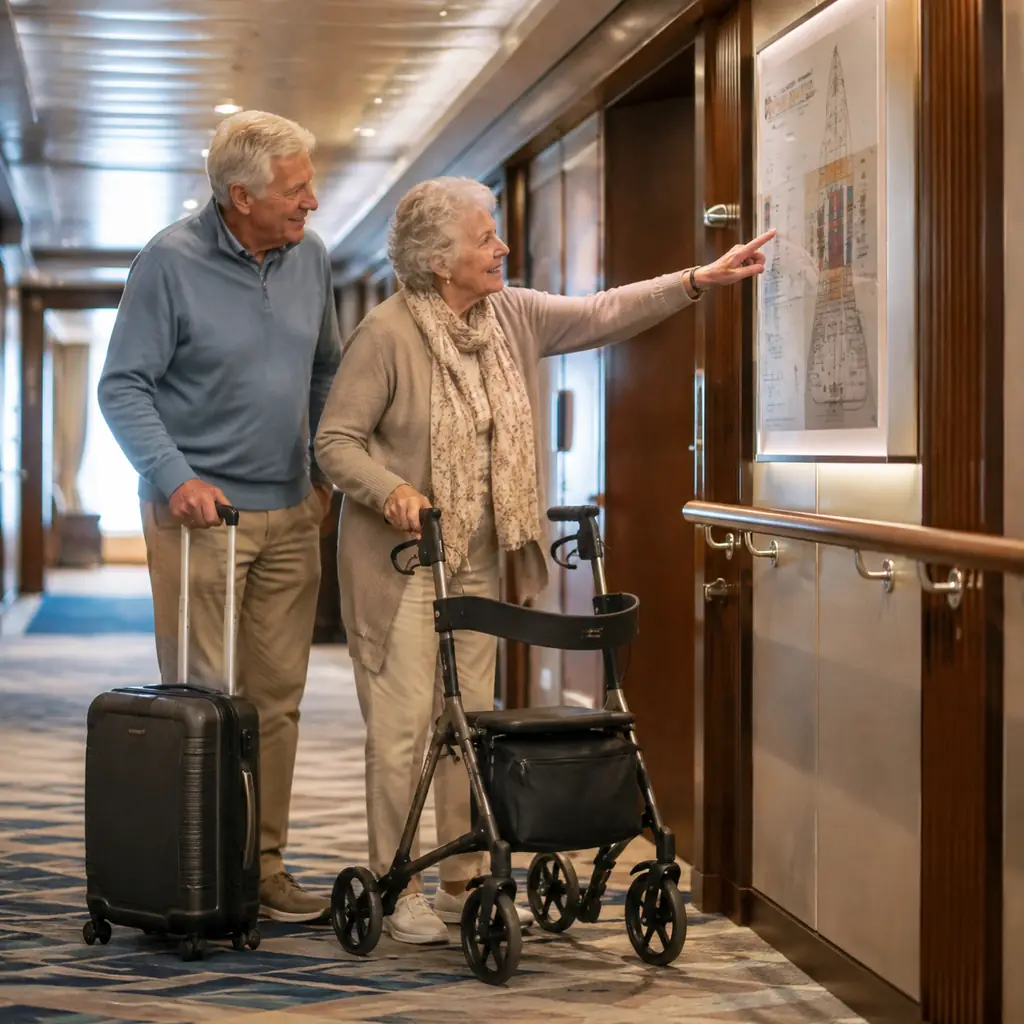
Pull up deck plan. Call ship and ask how far from dining area cabin is. Don’t accept the answer of midship. Ask them to count doors and tell you how many from nearest elevator.
If you have CPAP or other medical equipment, ask when you’ll be required to submit paperwork. Find out where oxygen tanks are allowed, whether you can store them in your cabin. Ask about storage of walkers, scooters and other devices.
Believe me, the difference between cabins can be thousands of steps during the course of a cruise. Also, it’s not necessarily pleasant to have a cabin directly opposite elevator. There’s lots of commotion at night when folks come back from bars. You’ll be awakened by the ding.
Ask about accessible cabins, how many are on board, whether there’s a lip into the shower, if there’s a seat, grab bars, extra space by the bed, etc. Find out how wide the door is.
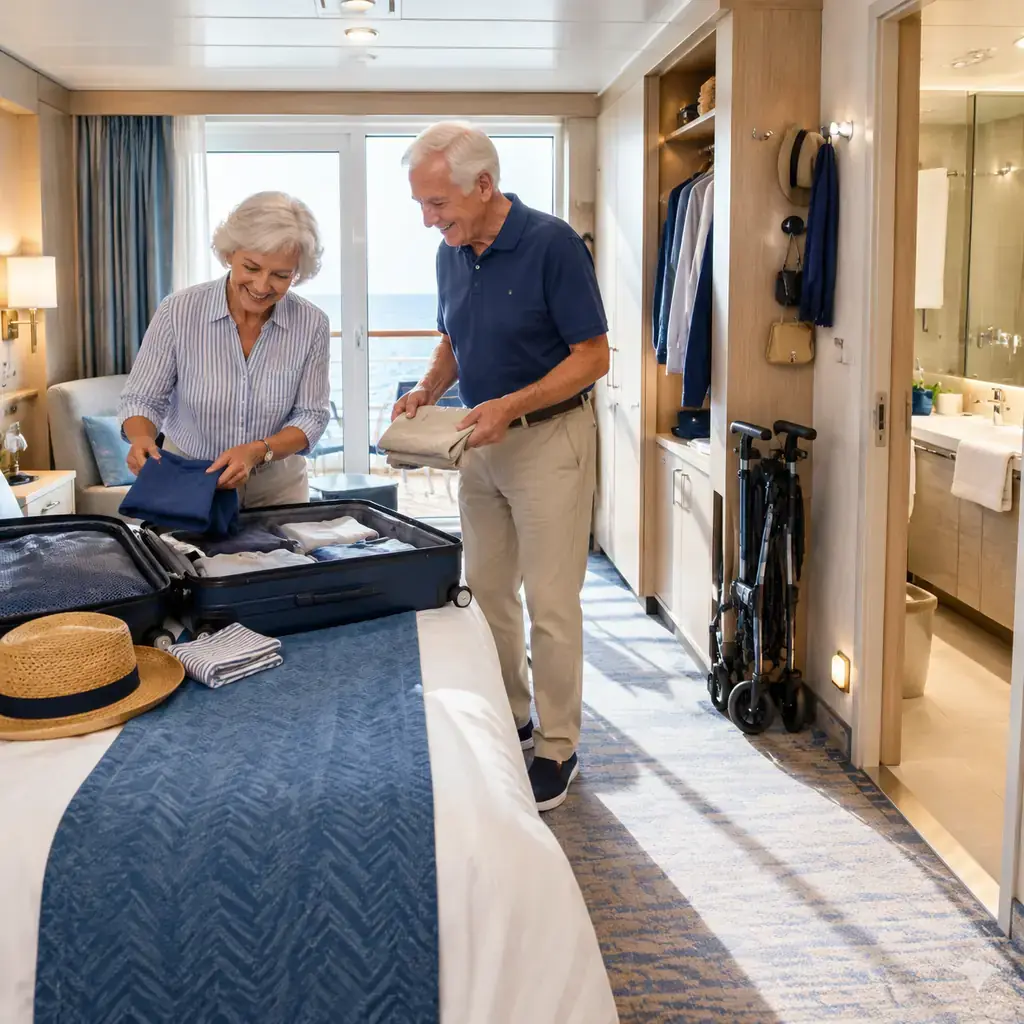
Unpack as soon as you get to cabin. You may think there’s tons of space but trust me, with door to bathroom open, especially if you have walker or scooter, bags, trays, etc., it’ll feel cramped. Leave walkway open from bed to bathroom. Empty bags can go under bed. Invest in night-light for bathroom trips in a.m. Battery-operated is best, will prevent you from turning on harsh light.
Cruising can be relaxing but boarding isn’t. You’re up and at it before breakfast, trudging down the ramp, waiting in security line, standing on concrete in the terminal. Try to arrange assistance. If you have someone traveling with you who can hand big bags to the porter, great.
Make sure you have all meds, reading glasses, sunglasses, boarding pass, passport, etc. that you might need before lunch on boarding day in an easily accessible area of your carry-on luggage.
Once you’re on ship, resist urge to find dining desk right away and resist urge to go to Guest Services right away. There will be tons of people there. Grab a glass of juice or water and find somewhere to sit and relax for a bit.
Have one bag if possible. If you must bring two, put anything you might need before lunch on boarding day in one and leave beach towels, book, etc. in other. Read more: pre-cruise checks travelers often forget. Read more: boarding-day mistakes.

Take it easy. Walk around and find dining room, infirmary, a nice spot on the outside deck, get a sense of how to get back to your cabin. Enjoy the fact that hallways are empty. Take a photo of the deck plan in case you’ll need it later when hallways and elevators will be mobbed after a performance in one of the theaters.
Port Days Reward Restraint More Than Stamina
Ports are very different. Some are container ports, others anchorages where you’ll be taking tender (small boats) into port, others take you right into charming little towns. Read up on ports beforehand.
Ask about how hot it is, how far you’ll be walking, how many stairs you’ll encounter, how difficult it’ll be to get onto the bus, and whether there will be restrooms available.

Many excursions describe themselves as easy or moderate. But what sounds easy may be difficult given your abilities.
Royal Caribbean’s accessibility info notes that accessible excursions are available only in some destinations, equipment like ramps and lifts varies by port, and ADA standards for facilities ashore don’t apply outside the United States. Ask about accessibility before booking an excursion if needed.
Check to see if scooter is allowed on tender, though usually they’re not if there’s no roll-on boarding, find out if you’ll be taking tender or docking, research terrain, climate, what’s available.

If you have mobility or balance problems, avoid excursions that are strenuous or involve a lot of stairs. Don’t over-schedule yourself on port days. Choose one thing you want to do and plan accordingly. Remember, the goal isn’t to see everything. You’re on vacation to enjoy the freedom of having nothing to do, make new friends, relax, enjoy the experience. Remember, you’ll be in port for a limited time. Choose wisely.
Remember, for example, that “moderate walking” could include a lot of walking and may include stairs, “moderate walking on cobblestones” could include lots of balance challenges, “a 2-hour walking tour” could mean standing and moving without a seat for forty minutes. Consider the circumstances of your hardest hour, not your best hour, as you browse shore excursion descriptions.
Similarly, “a visit to the waterfront” on a balmy 72°F day is one thing. The same visit at 90°F with no shade is quite another.
Many seniors prefer to get off, see what they want to see, and get back. If you’re one of them, a short excursion may be plenty. Consider your stamina and any medications you must take at specific times as you browse excursions. If you do a short excursion in the morning, you may be back with plenty of energy for dinner. Read more: things first-time cruisers do that give them away.
You might find it fun to strike out on your own. But plan carefully if you do. Allow plenty of extra time to make sure you’ll be back before the ship leaves port. Remember that the ship generally waits for excursions it hosts. It may not, however, wait for you if you’ve chosen to explore on your own and encounter an unexpected traffic snarl, a broken lift, or a line at the gelato cart. Carry the all-aboard time, the name of the ship, where it’s berthed in the port, and a phone number for a port agent, which you can get from Guest Services before going ashore. Keep a copy on paper and on your smartphone and give another to a trusted travel companion.

Stay on board if you like. You may be surprised by how much you can see and do staying on your ship, especially if it’s in port. Elevator lines are shorter, pool areas are less busy, and you may find shorter lines at the dining room.
You may be tempted to sign up for many tours. But the best tour for you isn’t necessarily the most active one, nor is it necessarily the most expensive. Instead, choose excursions wisely. Read more: cruise purchases worth checking before you pay.
Your Body Keeps Its Own Schedule, Even When the Ship Does Not
Some cruisers print out the daily cruise schedules, highlight everything they want to see or do, and rush from activity to activity from seven in the morning (breakfast!) to midnight (still dancing!).
Others find this approach exhausting.
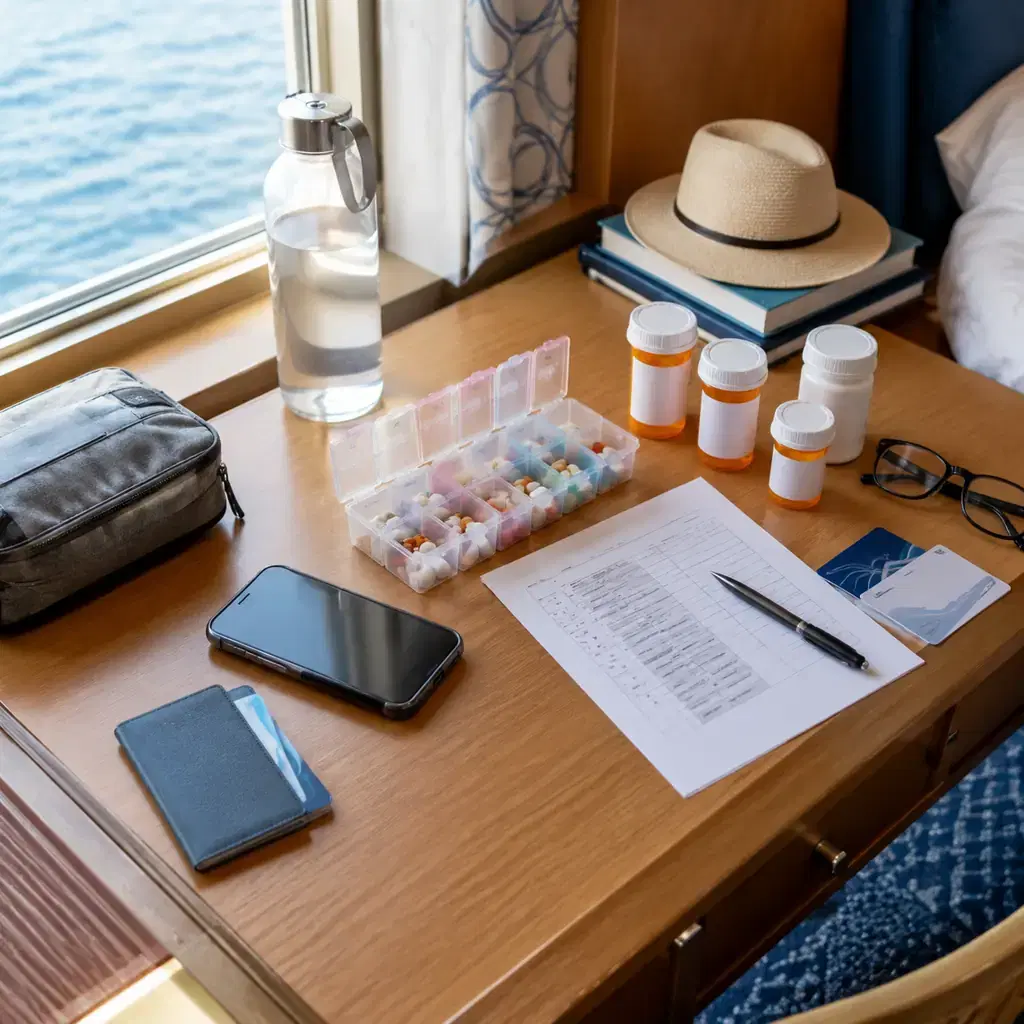
Carry all your medications and a few extra doses in your carry-on luggage as you board the plane to get to your cruise. Bring a list of your medications, dosages, and schedules, and photograph the list and carry that on your smartphone as well. Set alarms on your smartphone or use your pill case’s alarm.
A cruise disrupts daily routines. Especially during the first couple of days, medications are challenging since breakfast may be served at an earlier time than usual and dinner is served later. If the cruise also crosses time zones, medication management gets even trickier. Compare your typical daily schedule at home with the daily schedule on the cruise and write down when you’ll be taking your medications while cruising. Ask your clinician or pharmacist how to handle medication timing across time zones.
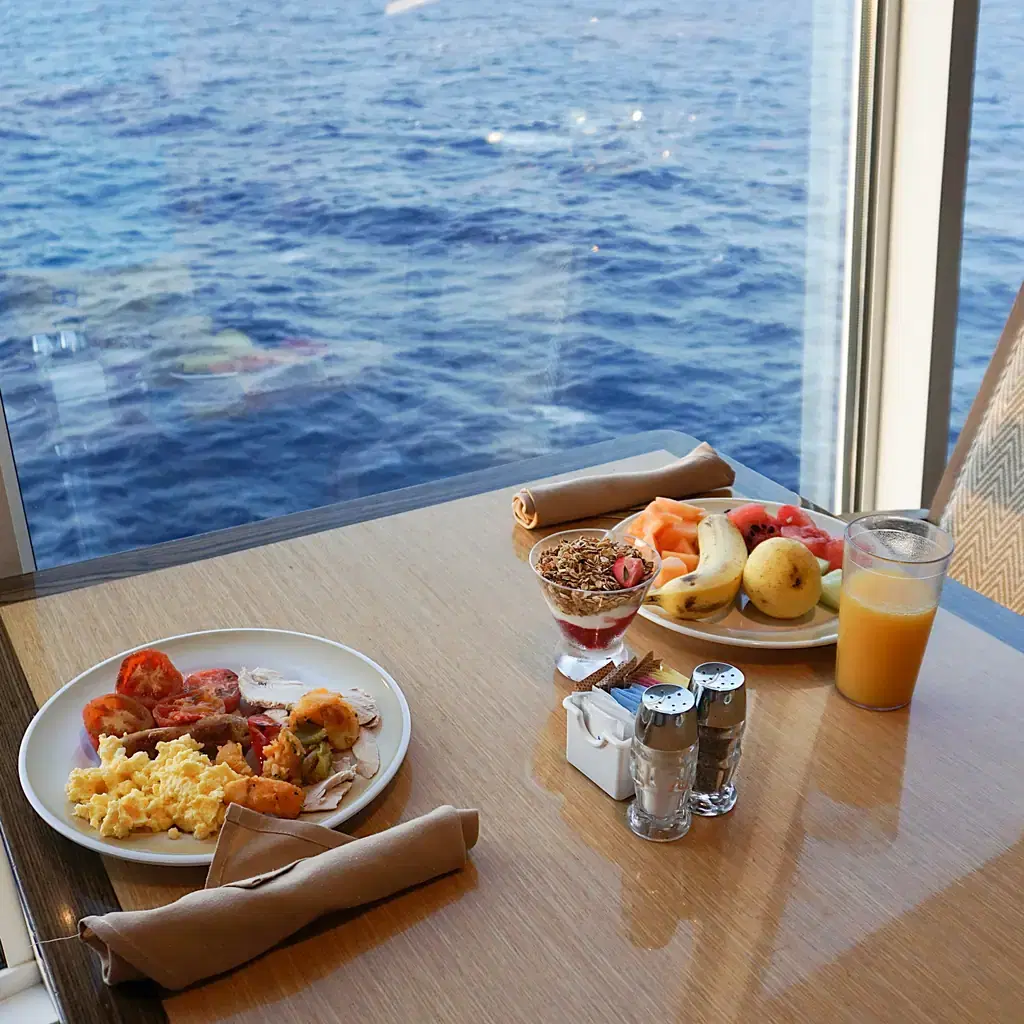
Eating on a moving ship can be challenging for anyone prone to seasickness. Carrying a tray through the buffet can be doubly challenging. Try eating in the more stately main dining room instead.
Ask for a table toward the wall to avoid the roar of dishes and people. Spare hearing aid batteries are also wise if you wear them.
Take precautions to prevent falls. Wear closed shoes with good grip. Watch out for shiny floors and unexpected changes in floor texture, such as damp carpets on outdoor decks.
Use railings and take your time. And when stairwells are busy, consider taking an elevator instead of risking a stumble on the stairs as the ship rolls.
Cruising can trigger motion sickness in some people who aren’t otherwise prone to it. If you’re easily seasick, plan accordingly. According to the CDC, talk to a doctor or pharmacist before taking motion sickness medications, as some cause drowsiness and have dangerous interactions with other medications. Read more: CDC advises travelers who expect seasickness to discuss medicine with a healthcare professional.
It’s also good to consider your itinerary since some are more likely to be rough than others. Learn more in our article about seasickness. Read more: world’s rougher cruise passages.
Wake up each day, look through the list of activities, and decide on one or two you’d like to attend, one in the morning, another in the evening, maybe. Then check off the rest of the day with a big fat X. If you’re feeling peppy, you can always add something later. Or you can enjoy a relaxing day without guilt.

If you get tired during the day, take twenty minutes in your cabin. Draw the curtains, prop your feet up, close your eyes, breathe deeply. You may feel ready to go again before you know it.
Save energy by avoiding peak times whenever possible. For example, instead of boarding the tender or shuttle bus when it pulls up, wait for the rush of disembarking cruisers to die down, then board. Instead of waiting for the elevator when it’s surrounded by a madding crowd, sit nearby until the rush passes. Instead of staying to the end of a show, leave early. These little tweaks to your day will conserve your energy for things you love.
The Medical Fine Print Deserves More Attention Than the Buffet Menu
Cruises offer a lot of value for the money, but there’s no free lunch when it comes to health care. Ships have medical centers that can either treat passengers, transfer them to a hospital ashore or evacuate them in serious situations. However, those centers aren’t full-service hospitals.
If you’re cruising internationally or outside U.S. waters, make sure you’re covered for medical costs abroad. Original Medicare usually doesn’t cover health care in foreign countries. Medicare Part B may cover medically necessary onboard care if the doctor is legally allowed to practice on the ship and the ship is in a U.S. port or no more than six hours from one when you receive care. Check how your own plan covers care abroad and evacuation. Read more: Check Medicare’s current foreign-travel rules.
When considering travel insurance, carefully read the policy and ask about limitations on medical expenses, preexisting conditions, medical evacuations, age limits for purchasing, exclusions and situations that require calling ahead for approval, before buying. Learn whether you’ll be reimbursed for medical bills or the insurance company will pay providers directly.
No matter where you’re traveling, bring a credit or other payment card that has ample funds available. Shipboard medical expenses are commonly charged to your cruise account, and if you have to see a doctor in port, you could be responsible for paying bills right away.
Cruises require identification, but not necessarily a passport. But the U.S. State Department still recommends bringing your passport book on cruises in case of an emergency, like needing to fly home, or if the cruise line reroutes to an unexpected port. A passport card cannot be used for an international flight home; you need a passport book. Also check passport expiration dates well ahead of paying in full for a cruise, especially if it’s an international voyage. Read more: U.S. State Department recommends that cruise passengers carry one.
The Centers for Disease Control and Prevention recommends having an appointment with a doctor or other health care provider at least four to six weeks before traveling. Also ask your doctor if there’s anything you can do before setting sail to maximize your health and safety. Bring enough prescription and over-the-counter medications to last longer than planned, in case of delays, and pack them in your carry-on luggage. Keep medicines in their original, labeled containers and check destination restrictions.
Ask your doctor for a one-page summary of your medical issues in plain English that you could show a physician in case of an emergency. Include diagnoses, allergies, medications, doses, any devices such as a pacemaker and recent lab tests.

Prepare for a “bad Tuesday.” This is the scenario where everything goes wrong: Your hearing aid battery dies, you lose your eyeglasses and realize that your wallet is still in the hotel. Assemble a kit that includes backup prescriptions, contact lens cases, medication, hearing-aid equipment, a copy of important documents like insurance information and medical records, and so forth.
Keep a hard copy of these documents in your cabin safe, and have your traveling companion carry a copy on her or his person. Make sure he or she has access to your wallet and other important belongings in case you’re sick or hospitalized.
If you have a condition that might get complicated while cruising, ask your doctor what kinds of treatments might be required and make sure they’re available.
Follow common-sense steps to avoid contracting germy bugs and spreading them to others. Wash your hands with soap and water, not just sanitizer, after using the toilet and before eating. Tell ship’s medical staff if you’re experiencing symptoms of a communicable illness, including vomiting, diarrhea, fever, cough, sore throat or a runny nose.
Insurers will provide an emergency phone number in case of medical or other issues. Save this in your phone and make a hard copy. Read more: 17 ways to fit two weeks into one carry-on.
Asking for Help Can Make the Cruise Feel Bigger, Not Smaller
Ask for help when you need it and make life simpler.
It’s not giving up independence, it is independence.
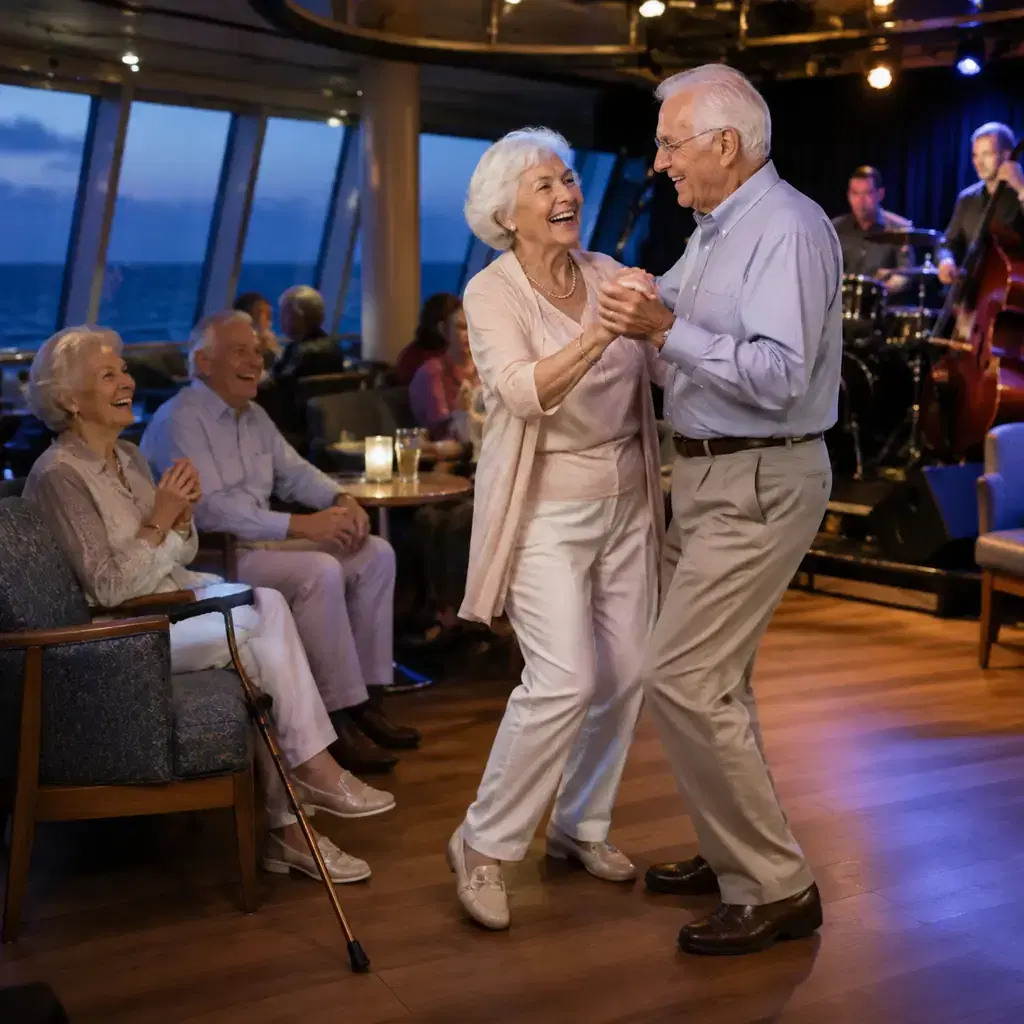
Request assistance with luggage and ask your travel companion to grab items on shelves above your head. Tell dining room staff that you need assistance, ask where quiet areas are on the ship, get a hard copy of the schedule, ask staff about an accessible route, store your walker somewhere convenient inside your cabin, ask for help getting to your room. This will conserve energy to enjoy yourself.
Try to dine with the same wait staff and interact with the same cabin attendant, so you’re not repeating your needs to a parade of people.
Socializing can be as simple as joining a shared table in the dining room or striking up a conversation in line at the coffee station.
There are plenty of inexpensive or no-cost things to do onboard a cruise, like crafts, card games, trivia, lectures, exercise programs and shows. Many of these happen in the same places each day. Read more: free cruise activities passengers often miss. Read more: common cruise add-on mistakes.
Travel with your buddy, but you don’t have to spend every waking moment together. Agree on a place to meet in the afternoon or evening.
Choose an easily recognizable location that won’t change, like “Outside the forward elevators on Deck 6,” so you won’t have to shout into thin air when you arrive before your companion.
The last day of a cruise is hectic. Elevator banks are mobbed, hallways are backed up with suitcases, and crew members scurry about, trying to make sure that everyone gets off. Breakfast closes earlier than expected. Leave your medications, keys, wallet, a change of clothing and other necessities you’ll need that morning out of the suitcases you leave out overnight for retrieval. Arrange help getting off through Guest Services before the last night.

Above all, relax. Cruises are supposed to be fun. Make sure that’s how they are for you.
Cruises simplify travel by taking out driving, cooking, repeated packing and unpacking, checking into and out of hotels and arranging transportation from one destination to the next. Make the most of this.
Final Thoughts
Going on a cruise at octogenarian age comes with special considerations. Plan ahead for medical and financial contingencies.
Don’t worry about doing everything on offer. You will have a much better time if you’re relaxed and enjoy what’s on offer at your pace.
Ask for help, accept help, use help. It’s easier than you think, and it’s how you’re supposed to do it, after all.
If you’re not exhausted and still have energy for more, you’ll know you had a successful cruise.
Comments
The opinions and views expressed in the comments section are solely those of the individual users and do not represent or reflect the opinions, views, or positions of HumbleTrail. HumbleTrail does not endorse, support, or verify the accuracy of any user-generated content.
By posting a comment you agree to receive related emails from HumbleTrail in accordance with our Terms and Privacy Policy. You can unsubscribe at any time.